RX&SLAG, Paris
Chaz Guest
The Sugars at the Bottom
17/10/2026 - 21/11/2026
RX&SLAG Paris is pleased to present The Sugars at the Bottom, a major solo exhibition by American artist Chaz Guest, opening in October 2026, the week preceding Art Basel Paris.
The Sugars at the Bottom unfolds as a visual journal. Through this new body of paintings, Chaz Guest returns to the memories that shaped him, his childhood in Niagara Falls, New York, and his formative years in inner-city Philadelphia during the 1960s. Churches filled with gospel music, neighborhood streets, family gatherings, quiet moments of tenderness, and the rhythms of everyday life become the foundation of a deeply personal narrative that reaches far beyond autobiography.
The paintings return to a generation that Guest believes should remain firmly embedded in our collective memory. They remember a community that, despite systemic racism, redlining, and exclusion, found its strength in faith, gospel, family, and an unwavering love for one another. These are not paintings about oppression; they are paintings about what endured beyond it. They celebrate resilience, generosity, dignity, and joy, becoming banners of pride, survival, and hope.
The exhibition takes its title from a familiar expression: " the sugars at the bottom". Like sugar that settles unseen at the bottom of a cup, sweetness remains present even when it is not immediately visible; it simply needs to be stirred. For Guest, the phrase becomes a metaphor for the enduring optimism, generosity, and joy that sustained families and communities through hardship. Beneath struggle lay an irrepressible sweetness that could never be extinguished.
Guest’s paintings possess a quiet formal authority. His portraits operate less as conventional likenesses than as acts of historical repair, adopting the compositional gravity and painterly discipline associated with Western portraiture while redirecting that language toward Black subjectivity. The figures do not perform identity; they simply inhabit it with assurance. Rather than quoting the past, Guest absorbs the grammar of art history and allows it to speak in a contemporary voice, creating paintings that feel at once timeless and profoundly present.
Painting itself becomes an act of remembering. Guest builds each composition through successive layers of oil and sumi ink, allowing washes, revisions, and traces of earlier gestures to remain visible beneath the final image. Broad, fluid brushstrokes coexist with passages of remarkable precision, while restrained palettes of earth tones are punctuated by luminous whites, deep reds, and subtle golds. His figures seem to emerge gradually from the canvas, suspended between memory and presence. Above all, it is the eyes that anchor each portrait. Quiet, unwavering, and psychologically charged, they establish an immediate encounter with the viewer. Narrative gives way to presence; spectacle yields to dignity and interiority.
While rooted in personal memory, The Sugars at the Bottom speaks to a broader human experience. Throughout his career, Guest has described painting as a search " for the hue of humanity." His hope is that every viewer, regardless of background, will recognize something of their own story within these paintings, affirming his enduring belief that we are, ultimately, one race: the human race.
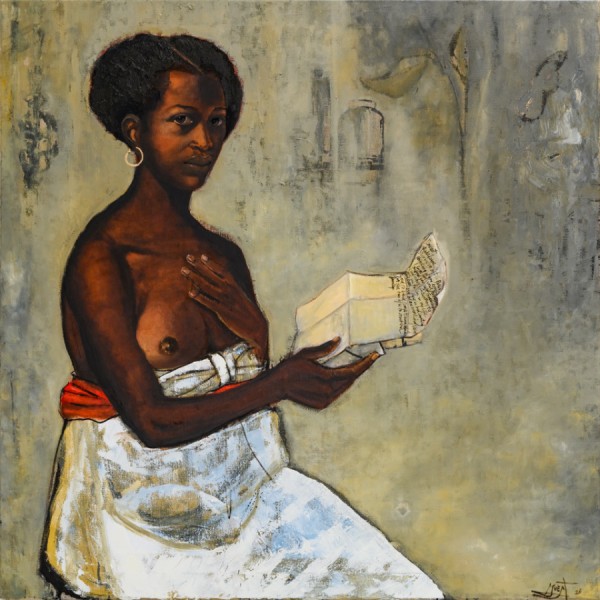
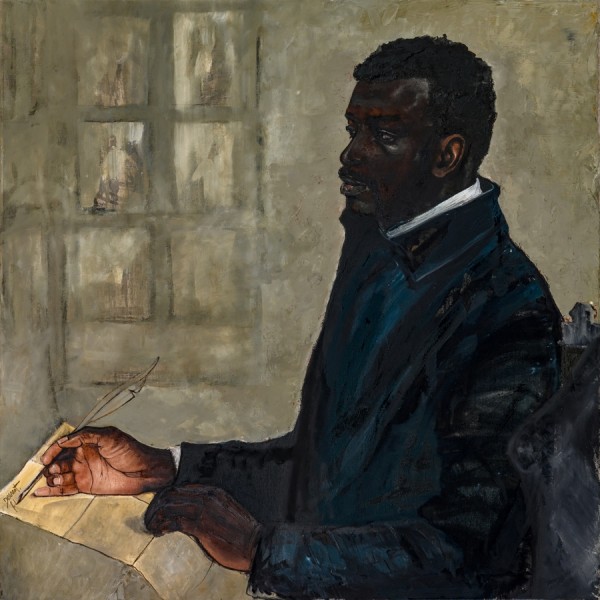
The exhibition also enters into a quiet dialogue with art history. One of its opening paintings, It Took Time, responds to Marie-Guillemine Benoist's Portrait of Madeleine, encountered by Guest at the Louvre. For more than two centuries, the woman portrayed by Benoist was known simply as Portrait d'une négresse before recent scholarship restored her identity as Madeleine. Guest carries that act of restoration further. Rather than revisiting the painting as quotation or homage, he imagines the life that history never recorded. Madeleine is no longer merely the object of another's gaze; she becomes the protagonist of her own story. In the companion painting, A Loving Pause, Guest introduces the man writing the letter she holds in her hands, transforming an anonymous historical figure into a woman who is loved, awaited, remembered, and addressed. Through this quiet yet radical gesture, Guest restores not only identity but intimacy, narrative, and emotional agency to lives long absent from the historical record.
Across the two paintings, history gives way to imagination—not as fiction, but as an act of human recognition. Guest reminds us that beyond every celebrated image lies an unwritten life, rich with affection, longing, memory, and hope. In doing so, painting becomes more than representation; it becomes an act of historical repair, affirming that dignity resides not only in being seen, but in being imagined as fully human.
Following Guest’s presentation at The Armory Show in New York and alongside a museum presentation at the Musée Eric Jacquet, The Sugars at the Bottom marks a significant new chapter in the artist’s practice. Bringing together works created during his residency at the Cité Internationale des Arts in Paris, paintings first presented at Fondation Florence, and an ambitious new cycle of paintings created for this exhibition, the project offers a compelling meditation on memory, history, and the enduring capacity of painting to connect individual experience with the larger human story.
In an age increasingly dominated by speed and spectacle, Guest’s paintings ask something rarer of the viewer: to slow down, to look, and to encounter another human presence with patience, empathy, and openness.