RX&SLAG, Paris
Kim Guline
Aux origines de l'abstraction, 1962-1968
05/09/2026 - 26/09/2026
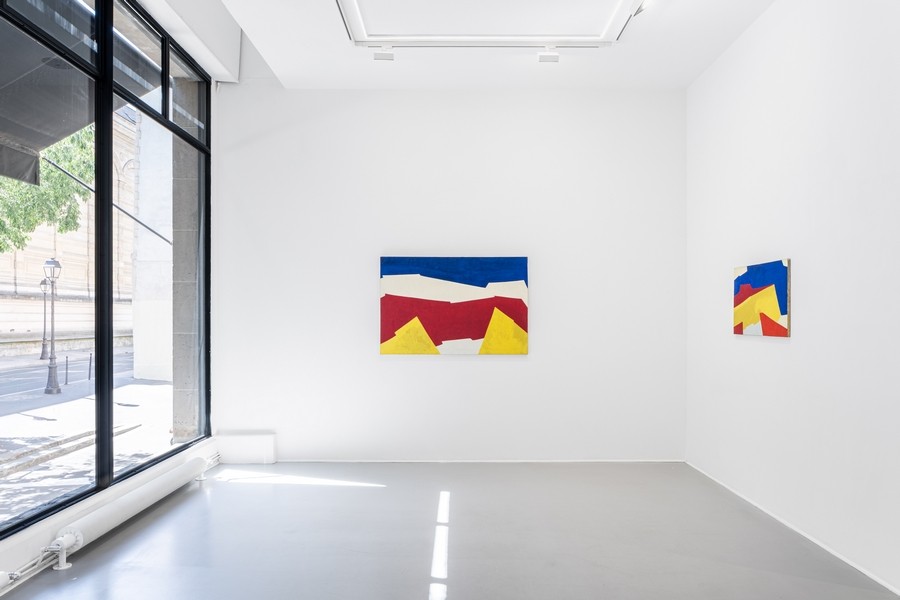
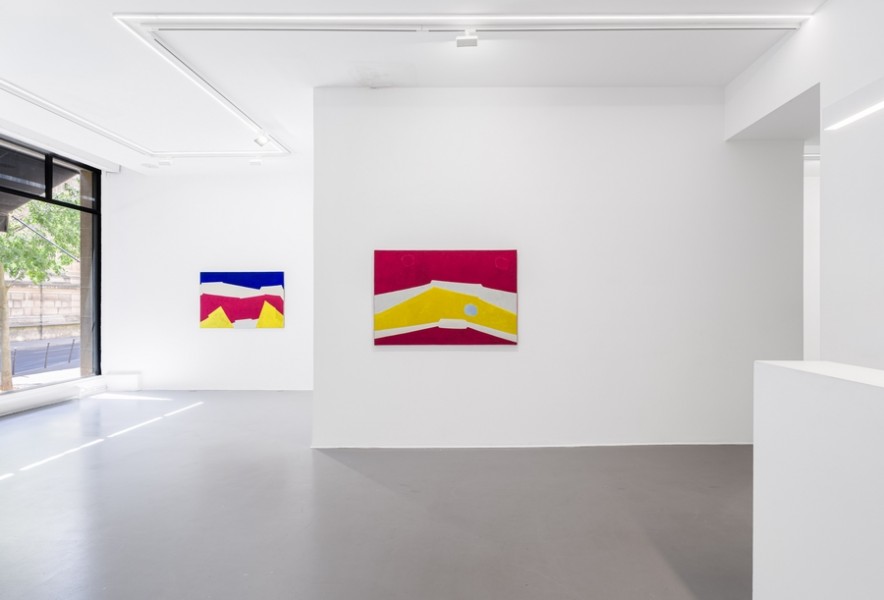
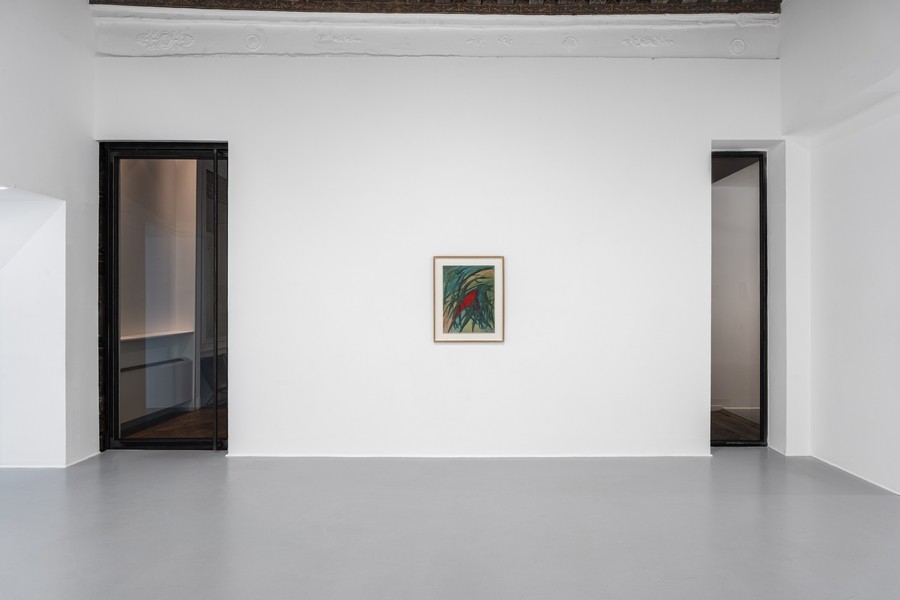
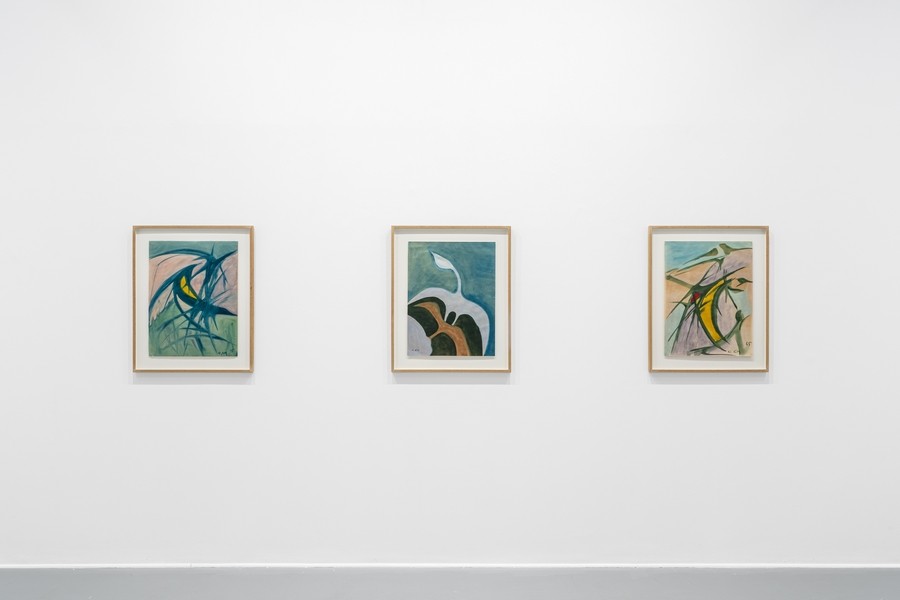
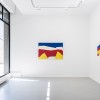
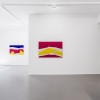
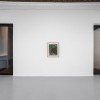
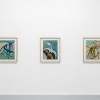
Kim Guiline (1936–2021) is now best known for the works he produced after the mid-1970s. Defined by the use of monochrome—or, more rarely, bichrome—these paintings, predominantly black, white, or rendered in a primary color, are animated solely by the contrast between repetitive, raised brushstrokes systematically arranged across the surface and flat, untextured areas occupying the edges of the canvas. These smooth margins often form a cross motif extending across the full height and width of the work. The principles underlying these paintings—the lengthy pictorial process, the surface manifestation of the painting’s internal structure, and a phenomenological approach that reduces the work to its purely visual perception—have already been extensively examined by critics and art historians. Earlier works, however, spanning approximately fifteen years, have received far less attention, with the notable exception of an exhibition held in New York in 2017. This relative neglect of the paintings from the 1960s and early 1970s can be readily explained by the difficulty of approaching a body of work that appears, at first glance, less coherent, owing to its rapid succession of distinct phases of research and experimentation. Moreover, the seminal nature of these early works is only rarely evident in light of the subsequent direction of the artist’s career. The reluctance to regard Kim Guiline’s youthful works as the direct predecessors of his mature production is further reinforced by the scarcity of opportunities to study them. This exhibition is therefore particularly welcome, offering the hope of filling a longstanding gap in our understanding of the artist’s career.
A passionate reader of poetry, Kim Guiline (1936–2021) specialized in French literature while studying at university in Seoul. When he left Korea in 1961, France was therefore the obvious destination. However, realizing the difficulty of mastering the language of his adopted country well enough to produce literary work, he exchanged the pen for the paintbrush the following year while studying art history in Dijon from 1961 to 1965. He then moved to Paris, where he attended the École nationale des Beaux-Arts before continuing his studies at the École nationale supérieure des Arts Décoratifs, graduating in 1971. His earliest known paintings, produced during this academic period, are landscapes characterized by heavy impasto and a remarkably free brushstroke. From 1963 onward, however, he radically simplified his pictorial vocabulary. Landscapes were reduced to schematic masses rendered in flat areas of color and sometimes invested with symbolic meaning, in a manner strongly influenced by Georges Braque, who died that same year.
Kim Guiline’s determination to simplify his visual language soon led him to eliminate all references to the visible world. Beginning in 1967, his works consisted solely of juxtaposed planes of vivid color. Through their forms and palette, some recall the paintings of Serge Poliakoff. Most of them, however, are distinguished by an even more rigorous geometric vocabulary, a highly restricted range of bright colors, and a spatial organization structured by horizontal bands interrupted by offsets and angular forms that enliven the composition. Several critics have interpreted these works as showing an obvious affinity with american Minimalism, particularly Hard-edge painting. Yet the direct influence of this movement seems to have been felt by Kim Guiline only from the early 1970s onward, following the major exhibition of American Minimalist artists held at the Grand Palais in 1968–1969. He then adopted even more reductive formal strategies. His works from the beginning of the decade consist of two nested rectangular planes created by collaging a sheet of paper onto the painted background of the canvas. These were soon followed by black monochromes in which barely perceptible geometric structures emerge, suggesting a close engagement with the work of Ad Reinhardt, whose paintings were exhibited at the Grand Palais in 1973.
These works of the 1970s clearly anticipate Kim Guiline’s later production through the economy of their means and compositions. By contrast, the investigations of the preceding decade appear to constitute a necessary path of development whose results only rarely found a direct continuation in the artist’s canonical oeuvre. Indeed, the first half of the 1960s was primarily devoted to a process of abstraction through which references to the visible world were progressively reduced to purely formal elements. It was the paintings of 1967 that marked both a decisive turning point and the first major achievement of the still-developing artist. Freed from all representational imperatives, their construction rests entirely on the spatial values of color—whose palette already foreshadows that of the subsequent periods—and on the use of geometric forms. For the first time, Kim Guiline produced paintings stripped of external content, existing solely as forms that carry their own meaning. In doing so, he gave visual expression to what he regarded as the fundamental principle of all poetic art: achieving the greatest expressive power through the most minimal means.
— Maël Bellec, Chief Curator of the Chinese and Korean Collections, Musée Cernuschi.